January 29, 2026
Internationally recognized research to address a real-world need got its start at a CREATE hackfest.
In 2024, students Lige Yang and Richard Li teamed up at the CREATE AI+Accessibility Hackfest to explore the concept of an AI tool that could monitor a person’s seated position, identify when they are in a posture that could cause injury or worsen an existing condition, and alert a caretaker with accurate, recommended corrections. Yang has continued developing the design.
From hackfest idea submitted by a parent…
The project idea was submitted by Max Smoot, the parent of a two year-old child with severe motor delays due to cerebral palsy. Smoot, who participated in the project development, described the need for a tool that exceeds what can be supported by current medical equipment and assistive technology.
The scenario: Constant vigilance and accurate intervention
- A growing child’s physical development can outpace their core and spinal muscle control, making it difficult to maintain a safe, stable seated posture.
- Poor positioning can make breathing difficult, can escalate to vomiting or aspiration, and can contribute to strain over time.
- Caregivers, often balancing many responsibilities, must monitor posture closely and intervene quickly to reposition the child.
Lige Yang, then a master’s degree student in Human Centered Design and Engineering, led design. Yang is now a product designer specializing in AI-powered UX, accessible health technology, and human-centered systems.
Richard Li is a Ph.D. student at the Paul G. Allen School of Computer Science & Engineering, contributed to the sensing, AI model explorations, and the technical concept. His work focuses on applying sensing and machine learning to novel interactions, accessibility, and health.
Max Smoot, a systems engineer in the Puget Sound area, was the primary developer responsible for system implementation, led the testing and validation effort, and collaborated on key aspects of the system architecture.

The team won second place at the hackfest by demonstrating technical feasibility, including using computer vision models to detect poor posture, formulate intervention recommendations, and send push alerts to caregivers.
… To award-winning design
After the hackathon, Yang joined the Neotic company, where she led project direction on Veya, focusing on the smarthome wellness feature. She conducted usability tests and optimized the user experience. She engaged with industry experts at AI and health experience design events and was able to expanded the product’s scope.
Two design events led to highly competitive professional milestones and awards for Veya and Yang: the MUSE Design Award and the International Design Awards Bronze Award. Recently, Yang presented the design at the International Design Awards in Thailand.
International Design Awards Bronze Prize
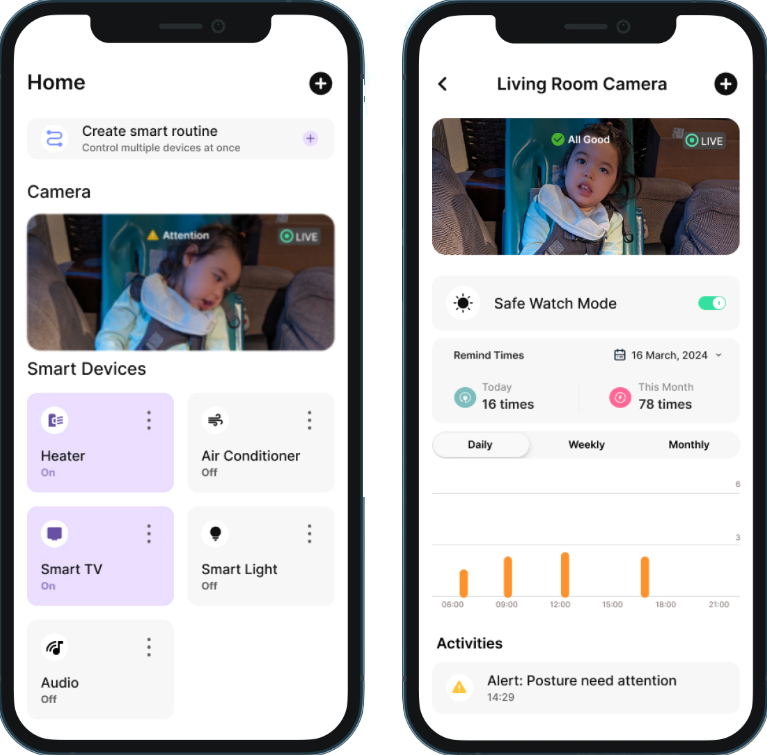
Company: Neotic
Lead Designers: Lige Yang
Project Location: Seattle
Prize: Bronze in Family & Children / Children’s Health and Wellness Products
Entry Description: Unlike wearable monitors that are uncomfortable, unsuitable for special chairs, and built for healthy bodies, Veya is designed for children with cerebral palsy. Its calm, accessible interface reduces stress in urgent moments, reassuring families while easing the burden of constant caregiving.
Currently, Yang is dedicated to establishing accessibility-first design principles, driving AI design advancements in the accessibility field.
Inspiration from the hackathon and advisors
Yang shared her thanks to the hackfest organizers (Kate Glazko, Jerry Cao, Venkatesh Potluri, Tony Fast, and Kathleen Voss) and community for the platform that brought attention to real-world accessibility needs and sparked her interest in designing and developing a solution.
“The hackathon revealed the vast, unspoken accessibility needs in the real world, sparked my passion as a designer to use technology to shine a light on these unheard communities,” says Yang.
– Lige Yang, MS 2024, Human Centered Design and Engineering
She also credits CREATE Director Jennifer Mankoff for Mankoff’s advice that she talk with different specialists. Yang followed the advice to meet with CREATE Advisory Board member Sean Kane and Brennen Johnston, Assistive Technology Support Technician at WATAP, a CREATE community partner. Both provided excellent advice centered on making sure the AI doesn’t mislead users, considering that caregivers, who are already facing stress, need a very shallow learning curve. And, of course, the system must be designed with accessibility in mind from the start.