March 9, 2026
If you drive, you’ve probably used route-finding apps with reasonable success. But these tools do not take into consideration people with mobility challenges who need information about sidewalks, not roads. Washington State’s first map of pedestrian infrastructure, OS-CONNECT, was a main topic at the recent OpenThePaths Conference. Organized by CREATE associate director Anat Caspi, the conference was attended by policymakers, city planners, disability advocates, and technology professionals.
Caspi is an affiliate assistant professor in electrical and computer engineering and directs the UW Taskar Center for Accessible Technology (TCAT) at the Paul G. Allen School of Computer Science & Engineering.

A vision for single-source data for the pedestrian realm
The goal of OpenThePaths and OS-CONNECT is to have accurate, updated, and usable data so that people with different mobility challenges can find routes that work for them and allow transportation officials to fix what isn’t working.
- Where are there sidewalks and are there ramps?
- Where are street crossing points?
- Are there steep hills or construction projects that obstruct access?
- Can transit be accessed without stairs and other obstacles?
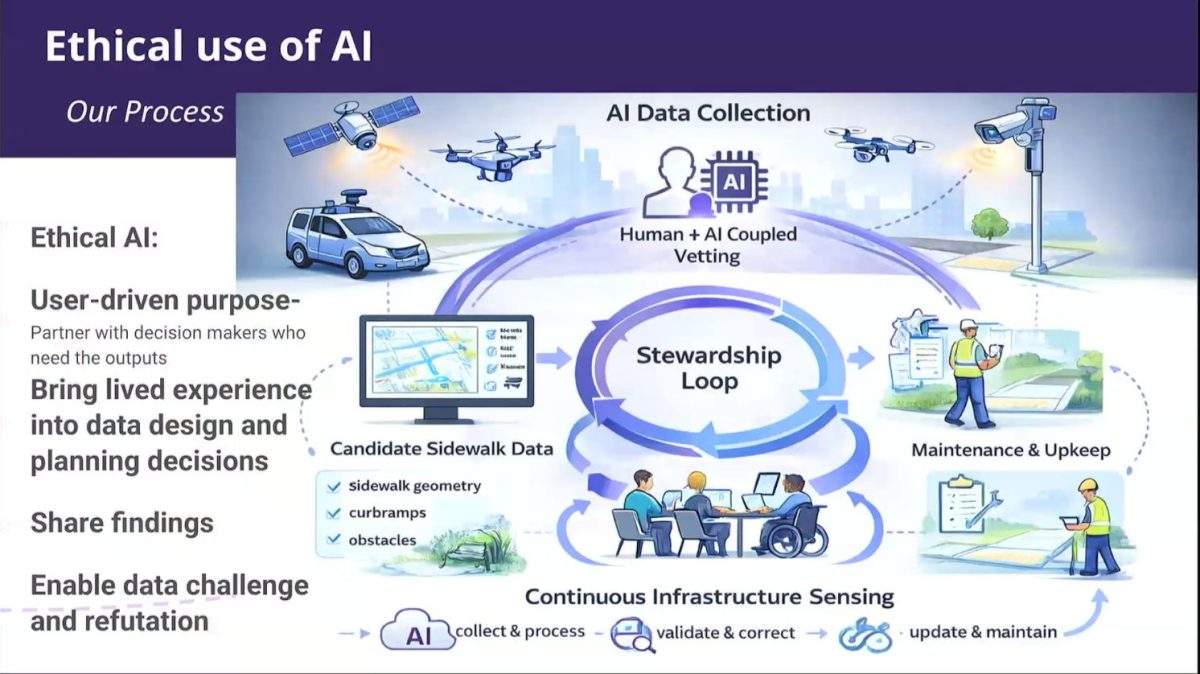
Ethical use of AI
In the Taskar Center model, data come from a variety of sources, some that don’t normally share data — such as aerial imagery, street cameras, and construction contractors — and is used by AI to create a real-time map. Caspi underscored that humans vet all information and will continue to vet and maintain the data shared.
Caspi acknowledged the many institutional barriers that prevent policymakers from “really subscribing to that shared vision and open shared data that supports non-drivers.”
“That will teach you a lot about how our system works and doesn’t work,” she noted.
Learn more
In a recent podcast, What It Would Take to Map Every Sidewalk in Your State, Caspi spoke about the need for and reach of OS-CONNECT and the conference. She also shared how her late daughter, Aviv, helped inspire her work, the tool named in Aviv’s honor, and the importance of ethical, human-centered, and anti-ableist AI.
More resources: