CREATE advances its mission — to make technology accessible and make the world accessible through technology — by supporting research that addresses accessibility needs in the disability community. Our research benefits from the varied expertise of faculty and students from the iSchool, Mechanical Engineering, Rehabilitation Medicine, Human-Centered Design, Disability Studies, Computer Science, and more.
Values-driven research
We focus on enabling people with disabilities to be part of the creation process, giving people with disabilities the education, voice, inspiration, and opportunity to enter and move through their education and into professional settings. This inclusive approach helps realize the disability mantra “nothing about us without us” as we pursue our ultimate goal: creating an inclusive and accessible world.
Disability-led
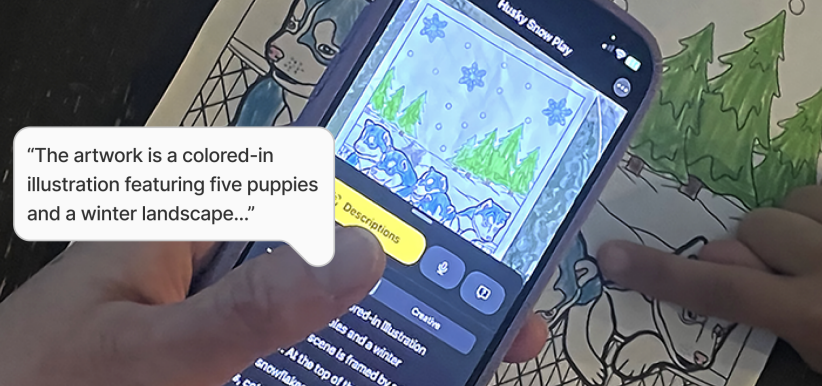
Guided by the principle ‘nothing about us without us,’ recent work includes studies of neurodiverse users of GAI; use of captions by multilingual people with disabilities; and blind and low-vision people interacting with digital and tangible media.
For all ages
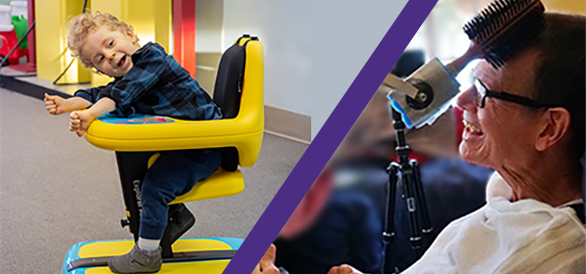
Work to improve agency for people with disabilities at all life stages: On-time mobility for children with disabilities; independence for elders through robotics; shared experience of artwork in mixed visual abilities families.
Multiple perspectives
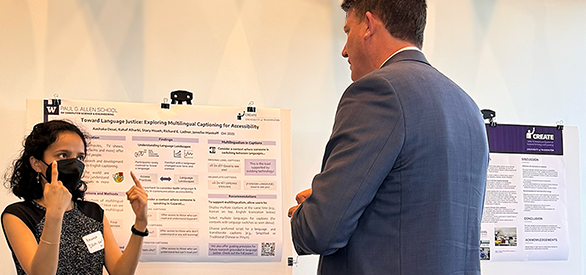
Studies look at how families with disabled children navigate support systems that may not allow for cultural diversity and whether AI can support speech-language pathologists to deliver equitable care to culturally and linguistically diverse children with disabilities.
Engaged stakeholders
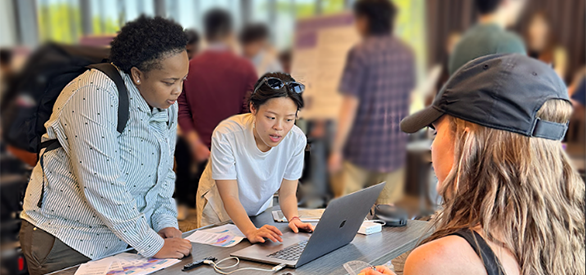
This year we forged new relationships with several regional and national disability-focused organizations. Twenty-two partnerships (and growing) connect our researchers with a wider, more diverse array of communities.
Energetic production and leadership
CREATE’s high-impact research in accessible technology and experiences included an emphasis on AI. Active AI research projects are addressing ableism, communication tools, health and activities of daily living, physical spaces and fabrication, digital accessibility and visualization, and interaction support.
CREATE and I-LABS completed their joint
investigation into early childhood mobility aids and
their effects on children’s neurological development
and have begun publishing their results.
54 Papers
published by CREATE faculty, students, and postdocs in the 2024-25 academic year.
Research impact
- CREATE research on bias in GAI resume ranking was cited by publications including Forbes Magazine and The Wall Street Journal and by prominent policy organizations American Printing House for the Blind and the Center for Democracy and Technology.
- CREATE researchers were invited by Zoom and Caption with Intention to consult about
possible improvements to videoconferencing and caption accessibility. - CREATE consulted on the UN Development Programme’s 2025 Human Development
Report about advancing human development for people with disabilities. The final report
cites recent CREATE research as well as earlier research by CREATE researchers about
disability studies perspectives on assistive technologies.
Recent research accolades
- Associate Director Jacob O. Wobbrock and Ph.D. alum/Advisory Board member Shaun Kane‘s paper, “Freedom to Roam,” was honored with a 10-year Lasting Impact Award at the ACM SIGACCESS Conference (ASSETS ’25).
- Associate Director James Fogarty was elected to the SIGCHI Academy in 2025 in recognition of his achievements in HCI research. Fogarty’s accessibility research includes a study of app accessibility cited by the Department of Justice and research on runtime repair of mobile app accessibility features that informed Apple’s pixel-based Screen Recognition.
- CREATE faculty Amy J. Ko, Professor in the iSchool, was recognized as a Distinguished Member of the Association for Computing Machinery in 2024.
Conference Awards
CREATE had another strong showing at this year’s CHI, RESNA, ASSETS, and MobileHCI conferences — with faculty and Ph.D.s winning 8 awards and honorable mentions for their papers and demos.
Highlights of CREATE’s high-impact research
AI and Machine Learning Research
AI has enormous potential to support needs and ways of being for people with disabilities. CREATE researchers are thoughtfully exploring AI’s implications for people with disabilities so they are included in the development and use of AI products and so they are protected from AI biases. Active research projects are addressing ableism, communication tools, health and activities of daily living, physical spaces and fabrication, digital accessibility and visualization, and interaction support.
More about AI and Machine Learning Research at CREATE
Early Access and the Brain
How do early experiences with mobility technology impact brain development and learning outcomes? CREATE is partnering with UW I-LABS to answer this and other questions. This joint work will demonstrate that early access to mobility technology is a critical asset for development and learning and also contributes to CREATE’s goal of understanding and addressing historical perceptions of disability and assistive technology, which often serve to perpetuate exclusion despite legislation protecting individuals’ rights to mobility and technology.
Ongoing collaborations with Go Baby Go and HuskyAdapt are providing early childhood access to accessibility tools.
More about Early Access and the Brain Research at CREATE
Mobile Device and Desktop Accessibility
Mobile apps have become a key feature of everyday life, with apps for banking, work, entertainment, communication, transportation, and education, to name a few. But many apps remain inaccessible to people with disabilities who use screen readers or other assistive technologies. CREATE is working to support automated diagnosis and repair of mobile app accessibility failures for all mobile apps. CREATE faculty are also exploring other aspects of mobile app accessibility, such as creating better touch screens based on how people with disabilities actually interact.
- Collected at scale accessibility data from 312 apps over 16 months
- Conducted qualitative accessibility evaluation of 30 popular Android educational games
100,000 Downloads
of Pointing Magnifier, a desktop pointing aid that makes the mouse easier to use for people with limited fine motor function
Mobility, Indoors and Outdoors
Mobility is a precursor to community living and engagement and is a critical equity issue. Two projects have been deployed in cities around the world:
Project Sidewalk uses deep learning and crowdsourcing to identify inaccessible sidewalks. Toward that effort, the team is developing scalable data collection methods to acquire sidewalk accessibility information via crowdsourcing, computer vision, and online map imagery. The data will be used to design, develop, and evaluate a novel set of navigation and map tools for accessibility.
Open Sidewalks seeks to make pedestrian ways, like sidewalks, first-class members of an open, routable transportation network. By collecting a connected network of path types with detailed attributes like width, surface composition, steepness, and shared traffic, Open Sidewalks provides routing directions personalized to the user’s unique disability needs.
Public Engaged!
21 cities working to improve pedestrian access
1 million sidewalk labels provided by users
More than 10 mapathons in the past year
Physical Computing for Accessibility
Physical computing, the combination of consumer-grade fabrication and computing technology, enables participation for people with disabilities in multiple home and community contexts. Now widely available, physical computing technology includes 3D-modeling software and machines such as laser cutters, 3D-printers, knitting machines and programmable embroidery machines. These technologies are already making a demonstrable and significant impact on community living and participation for people with disabilities in the form of 3D-printed tactile maps, customized tactile interactions on devices, specialized tools for creating assistive technology.
Through a NIDILRR ARRT on Physical Computing in Community Living and Participation grant, we are training postdoctoral fellows to be leaders in rehabilitation research who can harness advances in physical computing and fabrication to enhance community living and participation with people
with disabilities.
Race, Disability & Technology
CREATE’s cross-campus Race, Disability, and Technology (RDT) initiative was established to support emerging research. In collaboration with six campus partners, the initiative awarded three RDT minigrants in 2023-24:
- Professor Amy Ko for work on an accessible programming language
- Ph.D. student Aashaka Desai for work on multilingual captioning
- Ph.D. student Aaleyah Lewis for work examining the experiences of Black people with disabilities who use accessibility technologies.
Access, Equity and Inclusion
CREATE’s work includes efforts to improve data equity. Examples include our commentary on disability bias in biometrics; an autoethnographic study to test AI tools’ utility for accessibility; and development of a blocks-based language accessible to students with disabilities.
RESEARCH NEWS
Alumni Spotlight: Anne Spencer Ross
As a CREATE Ph.D. student, Anne Spencer Ross, Ph.D. CSE 2021, made her mark with an approach to accessibility research that was as novel as the final work was impactful.
ASSETS 2026: CREATE Papers, Presentations and Demos
August 31, 2026 CREATE faculty, students, and alumni will present their research at ASSETS 2026 in Porto, Portugal this October. Posters and demos are still being added. Let us know if we missed anything. Awards Wobbrock to receive the 2026 SIGACCESS Award for Outstanding Contributions to Computing and Accessibility Congratulations to Jacob O. Wobbrock on…
AccessMap expands beyond the sidewalk
September 21, 2026 AccessMap is an open-source pedestrian navigation platform that provides customized directions for people looking to avoid access barriers such as hills, construction sites, and high-clearance curbs. To prepare for thousands of FIFA World Cup fans visiting Seattle this summer—including many with disabilities—AccessMap researchers expanded the tool to include event-specific guidance. A pin…
Johnson, Glazko and Zhang highlighted for work on AI research for people with disabilities
July 1, 2026 Seattle’s Komo news highlighted the research of three CREATE researchers using AI to improve the lives of people with disabilities. Interviewed were Jazette Johnson, Kate Glazko, and Zhuohao (Jerry) Zhang. Dr. Jazette Johnson, a postdoctoral research fellow working with CREATE Director Jennifer Mankoff, studies the use of AI by people with cognitive…
Mia Hoffman awarded 2026 Graduate School Medal
June 29, 2026 Congratulations to recent graduate Dr. Mia Hoffman, Ph.D. 2026 Mechanical Engineering, on receiving the 2026 UW Graduate School Medal! Hoffman was recognized for her work to reimagine assistive technology for young children. She was also honored this year by UW Husky100 for “making the most of their time at the University of…